
Our Work / Fintech · Trading
AI Trading Systems That Know When Not to Trade
Automated trading systems for MetaTrader 5: research-grade backtesting, news-aware risk controls, an AI review layer and 24/7 cloud operation, built to protect capital first.
- 15 yrsof market history behind every strategy test
- 24/7unattended operation with self-recovery
- 1 clickkill switch, always one tap away
- 100%of experiments logged, failures included
Most trading bots don’t fail because of bad code. They fail because they automate an idea nobody has tested properly, then run it with nothing to stop them when the market changes.
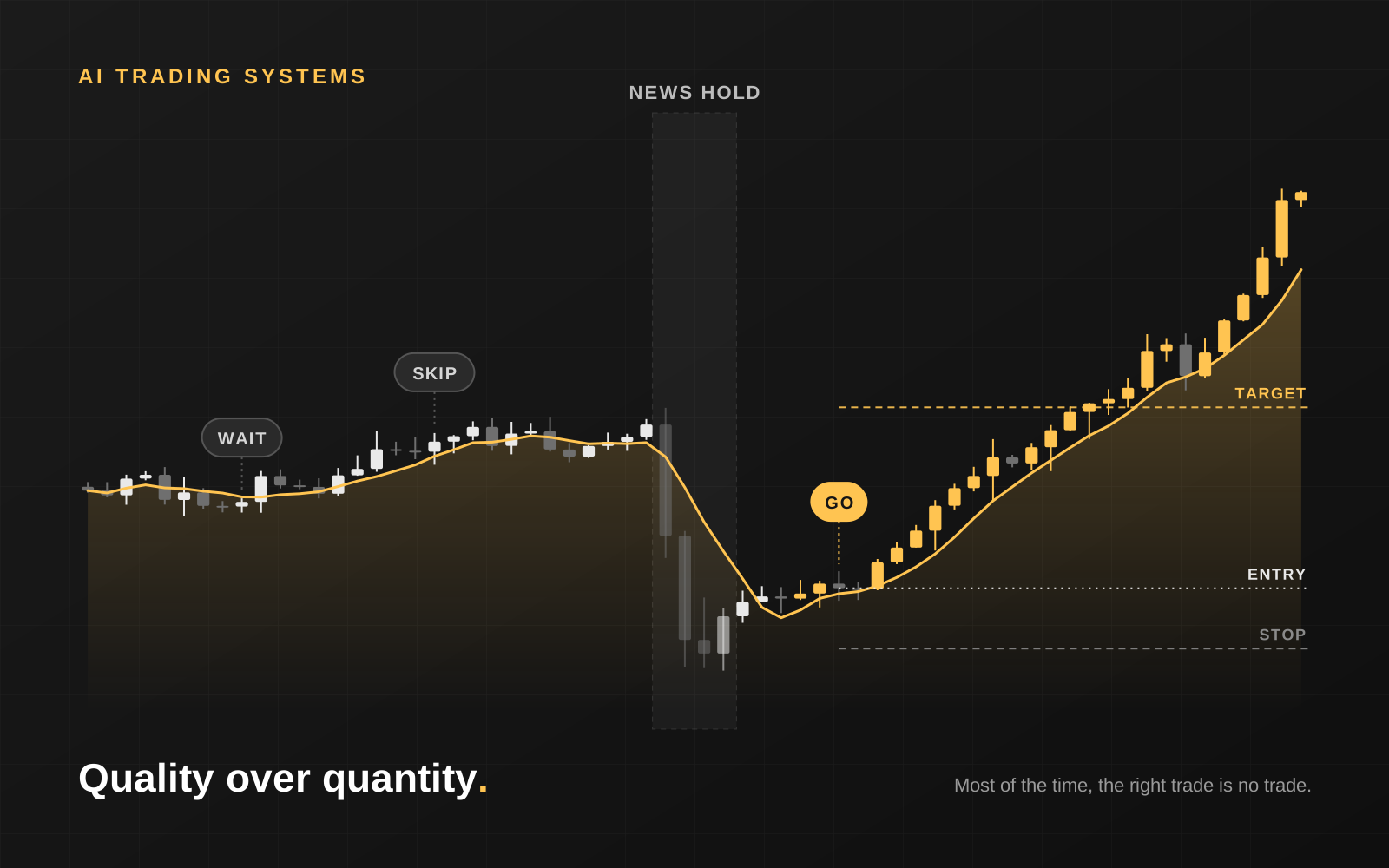
We build trading systems the other way round. Evidence comes first, automation second, and capital protection always. The result is a system that is comfortable doing nothing. It only acts when the setup, the market regime, the news calendar and the risk budget all agree, and it can explain every decision in plain English.
This page describes the kind of system we build for traders, prop-firm traders and small funds. Every engagement is custom and confidential. What stays the same is the engineering underneath.
What you get
- A strategy research lab that tests ideas against up to 15 years of history before they go anywhere near an account.
- A selective signal engine that reads market regime, structure and higher-timeframe context, and whose most common output is “no trade”.
- A news-aware risk gate that knows what’s on the economic calendar and decides whether to trade, wait, skip or hold.
- A hardened execution bridge into MetaTrader 5, with a hard stop-loss on every order and stop management that never adds risk.
- An AI review layer that reads every trade and writes you a daily report, without ever being in the trading path.
- A live dashboard with the system’s reasoning, simulations on request and a one-click kill switch.
- 24/7 cloud deployment that recovers from reboots on its own, plus plain-language runbooks for the owner.
Architecture
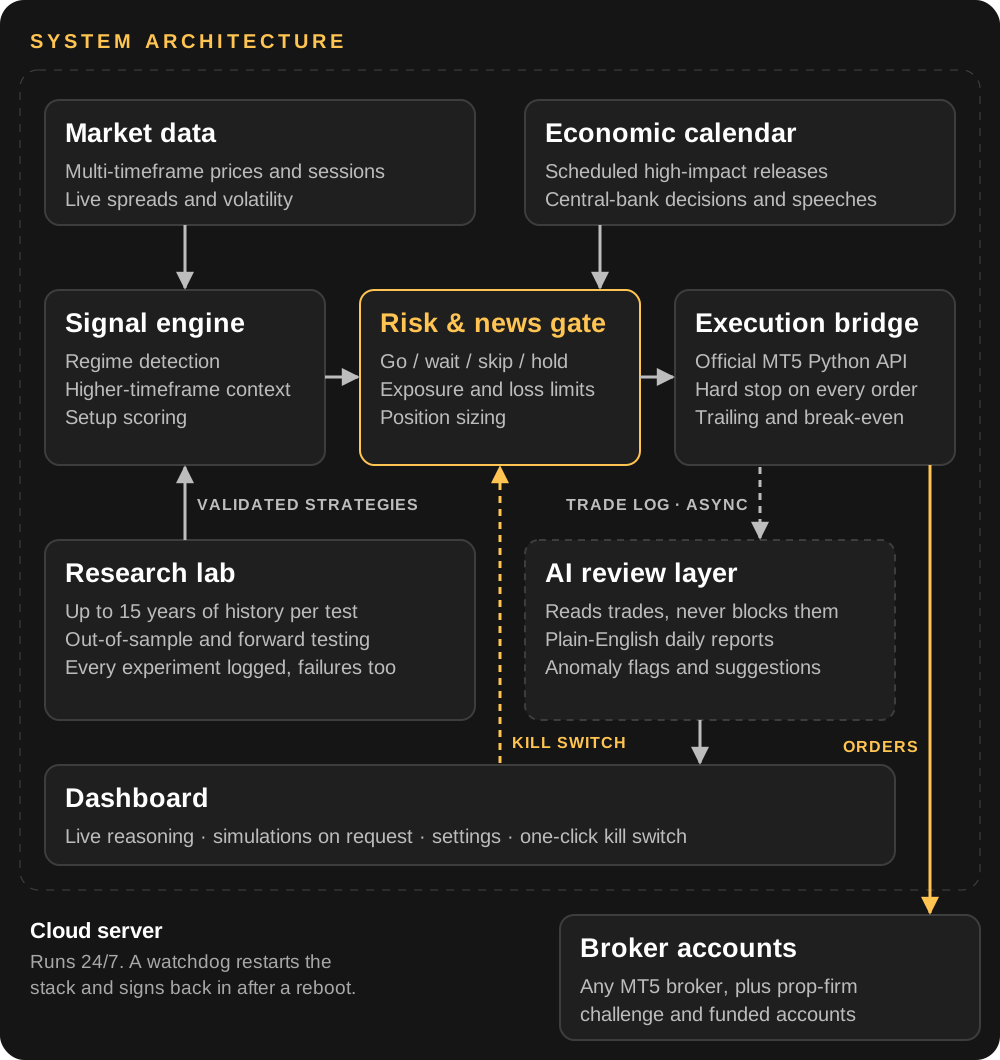
Each component has one job and a clear boundary. The deterministic core, from signal engine through risk gate to execution, makes every trading decision. Everything around it (research, AI review, dashboard) informs people, never the live order flow. That separation keeps the system fast, testable and auditable.
1. The research lab: proof before production
A strategy that looks great on three good months is a story, not evidence. Before any rule set is promoted to a live or demo account, it goes through the lab.
- Deep history. Strategies are simulated across up to 15 years of price data, covering trending and ranging markets, bull and bear phases, low and high volatility, session changes and major news periods.
- Honest splits. Data is divided into training, validation and out-of-sample periods the strategy has never seen, followed by forward testing on a demo account. A strategy that only works on the data it was tuned on is rejected.
- Overfitting guards. We favour fewer, explainable parameters over clever curve-fits. Results are reported year by year, so a single lucky stretch can’t hide weak years.
- Like-for-like comparison. Competing ideas run through the same harness, including a trader’s own discretionary approach once it’s turned into explicit rules. Decisions get made on equal terms.
- A complete experiment log. Every run is written down: what changed, why, and what happened, including the experiments that failed. Nothing is cherry-picked, and the owner can audit the whole research history.
2. The signal engine: highly selective by design
Entries happen on lower timeframes, where timing matters, while higher timeframes provide context and confirmation. A setup is only scored as tradeable when several independent conditions line up:
- Market regime. Is the market trending, ranging or in transition?
- Structure and liquidity. Is there a key level, a sweep, a break or a retest?
- Momentum and volatility. Is there enough movement to reach the target, but not so much that the stop becomes meaningless?
- Session. Different sessions behave differently, and the engine knows which one it’s in.
- Reward vs. risk. Before entering, the engine checks that the target is realistically reachable, not just mathematically attractive.
If the picture isn’t strong enough, the answer is no trade. A system that is comfortable taking zero trades on a bad day is one that survives the bad months.
3. The news-aware risk gate
Most bots handle news with a blunt filter: switch off around red-folder events. We treat news as part of the strategy.
The gate tracks scheduled high-impact releases (inflation prints, employment data, central-bank rate decisions and speeches, growth figures) and looks at the setup in three phases:
| Phase | What the gate checks |
|---|---|
| Before the release | Time to the event, whether an open position is exposed, whether new entries should be blocked, whether stops or profit protection should tighten |
| During the release | Spread blow-outs, abnormal volatility, price spikes not worth chasing |
| After the release | Spreads and volatility back to normal, then whether the move was a genuine trend, a reversal, a liquidity sweep or a false breakout |
Every setup comes out of the gate with one of four decisions:
| Decision | Meaning |
|---|---|
| Go | Setup and environment align, so the order is placed with full risk controls |
| Wait | Promising, but not yet confirmed. Keep watching. |
| Skip | Conditions aren’t good enough. Do nothing. |
| Hold | A news window is active, so no new exposure until it clears |
Every timing window is configurable: minutes blocked before a release, during it and after it, and the volatility conditions required before trading resumes. The system never assumes that every news event should be traded, or that every one should be avoided.
4. Risk management that can’t be argued with
The risk engine sits between the strategy and the broker and has the final say. Its limits are hard rules, not suggestions:
- A hard stop-loss on every order, sent with the order itself.
- Automatic position sizing from a fixed percentage of the account, so risk stays constant as the account grows or shrinks.
- Daily loss limit. Once it’s hit, trading stops for the day.
- Daily profit lock. Once it’s reached, no new trades, so a good day can’t be given back. It’s a ceiling, not a target, and the system never forces trades to hit it.
- Maximum total drawdown, maximum trades per day and a consecutive-loss circuit breaker.
- Trade management: break-even protection, trailing stops and optional partial take-profit. The trailing logic can only ever reduce risk, never increase the original stop distance.
- Prop-firm profiles. Challenge and funded-account drawdown rules are encoded as presets, so the same system can switch between personal-account and prop-firm modes with a settings change.
Every limit is a setting rather than a code change, so it adapts as the account’s purpose changes.
5. The AI layer, deliberately kept off the critical path
Large language models are powerful, but they are slow, metered and occasionally wrong. That makes them the wrong thing to put between a signal and an order. So we don’t.
The AI review layer reads the trade log asynchronously and works for the people running the system:
- Daily plain-English reports on what the system did, what it skipped, and why.
- Anomaly flags for behaviour that drifts from the backtest, such as unusually wide spreads, a run of skipped setups or an unexpected loss pattern.
- Improvement suggestions, which feed back into the research lab as hypotheses to test, never as live changes.
- Cost controls: capped call frequency and a hard spending limit, so the AI bill stays small and predictable.
If the AI service is slow or unavailable, trading carries on exactly as designed. Separately, the statistical models inside the signal engine retrain on fresh market data on a schedule.
6. Execution and portability
- MetaTrader 5 through the official Python integration, with every order sent together with its stop-loss.
- Broker-agnostic by design. Switching between MT5 brokers is mostly configuration: credentials, symbol mapping (brokers name the same instrument differently), contract size, margin and spread assumptions. One integration covers personal brokers and prop-firm accounts on MT5.
- Spread-aware entries. Trading costs are factored into reward/risk, and entries pause when spreads blow out, because a setup that only works on a zero spread doesn’t work.
- A live test order on deployment, sized at the minimum, confirms the full path from decision to fill before the system goes live.
7. A dashboard built for owners, not engineers
Not every trader wants to read logs. The dashboard turns the system into something you can watch and question:
- Live narration. See what the system is looking at and why it’s waiting, skipping or entering.
- Simulations on request. Ask, in plain English, how a variation would have performed historically, and get the answer from the same research harness.
- Settings without code. Risk limits, news windows and session filters, all in one place.
- Clear status. Connection and trading-loop health shown unambiguously, so nobody panics over a misleading banner.
- One-click kill switch. Always visible, always works.
8. Deployment and operations
- Runs 24/7 on a cloud server, so nothing needs to stay open on your laptop. Battery dead, lid closed, the system keeps working.
- Self-recovering. A watchdog restarts the stack and signs back into the trading account after any reboot or crash.
- Leaner hosting. We run MetaTrader 5 on Linux cloud machines rather than only on Windows servers, which typically cuts hosting cost.
- Everything in version control. Code, configuration and research history live in the client’s own private repository, so moving servers is a short, repeatable job.
- Demo first, always. Every new strategy version runs on a demo account before real capital is at risk.
- Plain-language runbooks. Step-by-step guides written for a non-technical owner: how to check status, pause trading, rotate credentials and revoke access.
How an engagement works
- Strategy and system assessment. Before writing code, we review your objectives, any existing strategy or journal, your risk framework and the accounts you’ll trade. The question is simple: what exactly are we trying to prove?
- Build the first version. The core system, research harness and risk engine. This part is fast.
- Research and validation. This is where the real time goes. Ideas are tested across years of history and out-of-sample data, then forward-tested on demo, and the ones that fail are logged and dropped.
- Deploy and operate. Cloud deployment, the dashboard, monitoring and AI reports go live on a demo account, then on a real one only when the evidence supports it.
- Iterate. Markets change. The lab keeps running, and improvements ship as tested versions, never as live experiments.
An honest word about results
Nobody can promise a profitable trading system, and anyone who does is selling something. Building the software is the predictable part. Finding and proving a durable edge takes time, and sometimes the honest answer from the data is that an idea doesn’t work.
What we guarantee is the engineering: a system that only does what it was tested to do, protects capital with hard limits, logs everything, explains itself, and keeps running when you’re asleep. That’s the foundation any edge needs to survive.
Trading involves substantial risk of loss. Historical and simulated performance does not guarantee future results. Nothing on this page is financial advice.